"We vote with our labor for the world we want to create. If you don't reflect on what you're doing, how do you know you're casting the right vote?" - Radhika Dutt
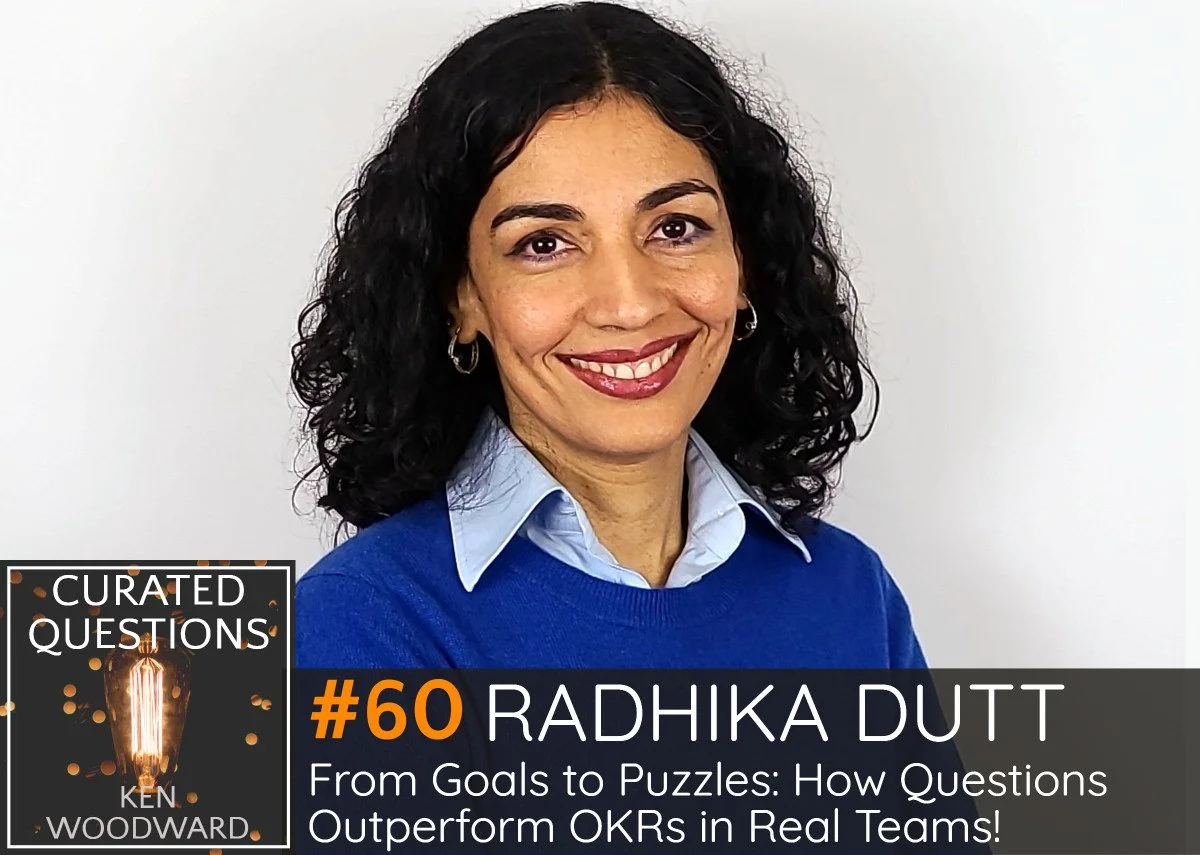
"We vote with our labor for the world we want to create. If you don't reflect on what you're doing, how do you know you're casting the right vote?" - Radhika Dutt
In this episode of Curated Questions, host Ken Woodward engages entrepreneur and author Radhika Dutt in a profound exploration of how questions can transform organizations from goal-driven to puzzle-solving entities. Radhika is the author of "Radical Product Thinking" and shares her journey from MIT to becoming a serial entrepreneur to developing the puzzle-based leadership OHLA framework (Objectives, Hypotheses, Learnings, Adaptations).
The conversation reveals how traditional goal-setting, rooted in 1940s assembly-line thinking, fails in today's complex environment, where creative problem-solving matters more than repetitive execution.
Radhika demonstrates through a live experiment how "puzzles" energize while "goals" burden, explaining that puzzles tap into internal motivation rather than external pressure. She emphasizes the critical importance of reflection, a practice she credits with enabling better decision-making both personally and professionally.
Drawing from her nine languages and global experience, including living in post-apartheid South Africa, Radhika offers insights on creating psychological safety for questions across cultures. The episode culminates with practical guidance on implementing puzzle-based thinking in organizations, showing how asking better questions leads to ownership, engagement, and transformative results.
This Curated Questions episode can be found on all major platforms and at CuratedQuestions.com.
Keep questioning!
Episode Notes
00:00 The Importance of Reflection
01:29 Introduction to Curated Questions
02:12 Meet Radhika Dutt
03:09 Radhika's Early Entrepreneurial Journey
04:05 The Power of Questions
04:56 Lessons from MIT
06:16 Creating Psychological Safety
09:41 The Role of Reflection in Leadership
16:03 Practical Reflection Techniques
20:10 The Impact of Reflection on Career Choices
21:10 Puzzle Setting vs. Goal Setting
29:57 The Dangers of AI Product Slop
32:51 The Value of Human Reflection in the Age of AI
38:42 The Gates Foundation and Malaria Eradication
43:03 The Flaws of Microloans
48:05 The Four O's Framework
50:43 The Dark Side of Metrics
51:40 Unintended Consequences of Targets
53:38 Apple's Business Model vs. Software Companies
53:58 The Pitfalls of Target-Driven Companies
54:24 The Power of Asking Questions
54:43 Experimenting with Puzzles
54:55 Goals vs. Puzzles: A Live Experiment
58:58 The Neuroscience Behind Goals and Puzzles
59:34 Research on Goal Setting
01:01:47 The History of OKRs and Goal Setting
01:03:00 The Shift from Repetitive Tasks to Puzzles
01:03:52 The Importance of Asking Questions
01:04:55 Implementing Puzzle Solving in Corporate Strategy
01:05:25 The OHLA Framework Explained
01:08:52 How This Framework is Different Than Lean Startup
01:18:23 Challenges and Learnings in Puzzle Setting
01:21:34 Building a Questioning Organization
01:28:39 Cultural Perspectives on Questions
01:33:40 The Impact of Upbringing on Questioning
01:34:57 Exploring Personal Growth Through Questions
01:38:56 Final Reflections and Takeaways
Resources Mentioned
Radical Product Thinking: The New Mindset for Innovating Smarter by Radhika Dutt
Monetary Authority of Singapore
What has the Gates Foundation done for Global Health?
Management by Objectives detailed in The Practice of Management by Peter Drucker
Drama of the Gifted Child by Alice Miller
OHLA Framework Toolkit (Objectives, Hypotheses, Learnings, Adaptations)
Radhika Dutt on LinkedIn
Questions Asked
When did you first understand the power of questions?
How were questions a part of that?
Did you actually push back or not push back?
Did you start to ask questions in that with that group, or was that something that was later on that you reflected back on?
What is our approach?
How did you lay the groundwork then for that to be a productive conversation?
Were there any particular items that you take away as insights as a leader that you've adopted that says, this is how I'm going to do work based on that experience at that company and how they were creating that space?
What is progress?
How do you create the psychological safety?
When you say reflection, what does that look like practically for you?
If you don't reflect on what you're doing, how do you know you're casting the right vote?
Has that realization for you caused you to change or make changes in your work and what you're doing?
What do I want to do?
What is it that I really want?
How is it affecting my family?
How well did that attempt work?
What did we learn?
If I gave you a magic wand, what would you ask for?
How well did it work?
What have we learned?
What will we try next?
Are you green, yellow, or red on track for targets?
What does this mean?
What can I do?
What are the real insights?
What does it mean? And therefore what will I do?
Do you know like what the neuroscience is on that?
How has your question practice grown over the years?
Why do you assume that this is the top thing that you have to work on?
Why eradicate malaria by 2040?
Is that what the developing countries need?
Is that the best cure actually, and is the cure based approach the right way?
Why is that happening?
What are some key either behaviors or causes that is leading to this?
And then what should we be doing for that?
How do we tackle malaria?
Do we know if 20 years ago, 30 years ago, when the Gates Foundation started all of this, do we know if they had that curiosity based approach then?
What has Gates Foundation done for Global Health? W
hat should we be solving for?
What is that puzzle, that curiosity and the questions we're missing?
Why hasn't it worked out?
How can you generalize in that way and say, everyone's an entrepreneur, all you have to do is give them a loan?
What is driving that goal?
What is the observation like, what are we trying to address?
What is this problem we're trying to address?
What are the open questions so that we can understand this observation?
Is it that something has fundamentally shifted in the market?
Do we know how to sell into the mass market?
Is our messaging working?
If we solve this problem, what is the opportunity that lies underneath that we can really tap into?
Why is this all worth solving?
Why is this puzzle worth solving?
What is the outcome?
What is the metrics fatal flaw?
What are some of those unintended consequences we may have as a result of putting that stake in the ground?
What can be the consequence?
How could that target backfire?
What, what was your insight or thinking in going to the language of puzzles?
What are your goals for your company this year?
How do you feel?
What puzzles do you want to solve for your company this year?
Why didn't we, from the beginning, have puzzles in corporate vocabulary?
Why did goals become the thing that's so entrenched in corporate vocabulary?
Where did he get OKRs from?
Where did he get it from?
What problem was he trying to solve?
So what's next in our process here?
How do we get back to that growth curve?
Is it the market?
Is it that we don't know how to sell to the mass market?
Is it that the product doesn't work for the mass market?
How well did it work?
What if we try this messaging instead?
Do we get meetings with decision makers?
So that was our first question.
How well did it work?
Now the second question, what did we learn?
What's going on?
What are we learning from these meetings?
If we had a magic wand, what would you do next?
What would we try next?
What's the easiest way to be able to get this decision maker and this supporting group, on our side?
How well did that work?
What have we learned?
What will we do next?
How is this different from Lean Startup where the idea is, you do constant experimentation?
Why aren't the tech averse people using it?
How do they work today?
What is their workflow like?
What are they doing?
Should I price it higher because there's more demand than supply, or should I price it lower?
Where does it bring value?
Why are you guys asking these very basic questions and wasting users' time?
You should know the answers to these, right?
Why don't you already know?
Why don't you know this as a leader?
If I'm given 60 minutes to solve the world's problems, I would spend 55 minutes, on the question and then five minutes on the answer?
Why didn't we think of this from the beginning?
What would you have to say about iterating in that question space and getting and working through all the wrong questions?
What is the problem statement or this observation?
What are the open questions?
What are things that we need to figure out?
What is the opportunity and what is the outcome?
I don't know the answers to this question. We don't have data on it?
How long is it gonna take you to even frame this puzzle better?
What is our first attempt going to look like?
How well did it work, what have we learned?
What will we do next?
How have you found the reception, within these organizations you've worked with?
How well did it work, what have you learned, what will you do next?
Are these numbers red, yellow, and green?
Was this a questioning organization before?
Was it a safe space?
How, how might this have changed to become more of a questioning organization?
What, what did that journey look like or what are you seeing?
How well did that go?
What have we learned?
What will we do next?
What worked well, what didn't?
What have we learned from this?
What are we going to do next in tomorrow's interview?
What does leadership witness in the hallway?
Are people asking each other questions, right?
How folks that speak multiple languages, what they've learned about questions by being able to speak multiple languages?
What's the Venn diagram for beauty that comes out of your understanding of questions?
You don't talk to a teacher like that?
What is the puzzle behind this?
Have you had a chance to use this in Japan?
What is your right now question or questions?
How has my upbringing shaped me?
How has it shaped me in terms of what triggers me, what drives me?
How are you exploring that?
Is that through journaling, counseling, or watching good movies?
Any particular one book recommendations as you've embarked on this journey?
Where is the best place for folks to track you down, follow what you're excited about and learn more about the work you're doing?